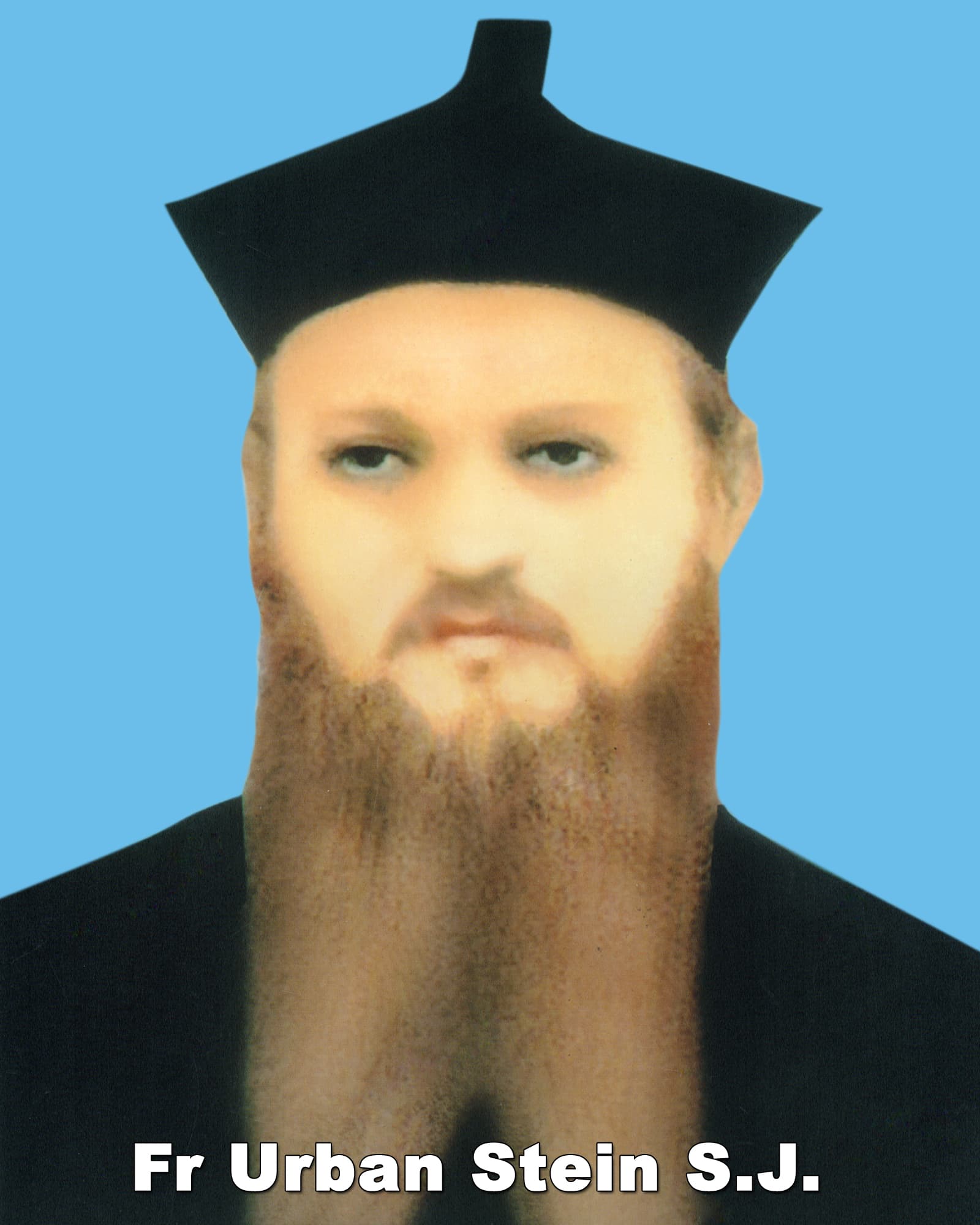
Fr Urban Stein was born in Cologne on the Rhine, called German Rome on August 21, 1845, of John Stein and Anna Elizabeth Durst. Right in his early years his pious parents left an indelible impression on him of their own simple piety and profound faith. At the devotional level his Christian life was built on a double foundation: a tender love for the Blessed Virgin and a singularly personal love for the Saviour in the Eucharist.
The boy Urban did his early studies at the Gymnasium of St Marcellus, formerly a Jesuit high School and at the age of 17 decided to join the Society of Jesus. On September 30, 1862 he joined the novitiate on the Friedrichsburg near Munster, Westphalia. His affability and refinement endeared him to all. Those who knew him well could also find in him a singleness of purpose, an unquestioning submission of himself to the demands of obedience and a burning zeal for the 'salvation of souls'. He pronounced his first vows on October 10, 1864 which was followed by further studies. He often exclaimed how privileged he would be if his Superiors thought fit to send him on foreign missions. His wish was fulfilled when on completion of his philosophical studies he was sent to Bombay, India. Urban worked incessantly combining active work with his theological studies and was ordained priest on December 22, 1876. On December 26, 1878 he came to Mangalore with the group of other Jesuits as Mangalore mission was then entrusted to the Jesuits. The youngest of the lot, hardly two years a priest, he had already proved his mettle to be entrusted with the responsibility of the largest and most important of the parishes in the vicariate - the Cathedral, dedicated to our Lady of Rosary.
Fr Stein had turned but thirty-four when he was made parish priest. Going round his parish and studying the state of affairs he did not have to wait long to realize that the neglect of spiritual life was the fountainhead of the evil in the parish. Day in and day out, using any means of contact at his disposal, he underscored the indispensability of the frequentation of the sacraments. Fr Stein's love of the Eucharist was so infectious that his flock responded with almost equal fervor. In a short period of time he brought about such a spiritual revival in his parish that it spread to other neighbouring parishes too.
He had a flock in his vast parish, with its multiple needs which must be attended to as effectively and expeditiously as possible. He needed others to join hands with him in this great task. There were a number of young Catholic ladies who on one hand unprepared to enter marital life and on the other unwilling for good reasons to enter a convent. It is to these he turned for help. His mind went back to his native city Cologne and the good work the Ursulines had been doing there. Obviously too he was conversant with the spirit and apostolate of Angela Merici realized so worthily by the Ursulines of Brescia and other places in Italy and Europe in general. Given his own Jusuit background which is apostolic through and through he started a pious association of ladies in the spirit of the Ursulines on Easter April 10, 1887.
Then the tragedy struck. His Superiors sent Fr Stein to Goa to obtain the documents and certificates from the Archbishop of Goa to pursue the case of the Padroadists who had refused to submit to the jurisdiction of the new Bishop appointed by the Propaganda namely Mgr Nicholas Maria Pagani. On his return to Mangalore he took a country boat as he could not secure a convenient ship. It was a fatal decision. His health broke down during the voyage. A relentlessly scorching and searing sun was too much for a Westerner. When he arrived in Mangalore on October 16, 1888 he was already in the jaws of death. Even to his last breath, however Fr Stein was a model of resignation and humility. He passed away on October 21, 1888, the feast of St Ursula.
Effective Teaching of Catechism
Practice of Monthly Communion day, full day Adoration
Regular participation in the Sacrament of Penance and Eucharist
Visits to the sick
Establishing the sodality of the Blessed Virgin Mary, Congregation of the Sacred Heart, Sodality of St Joseph for Tailors, Sodality of the Children of Mary for girls
Library with Catholic literature
Organizing Teachers for Christian Doctrine
Promotion of Secular Education
Founding the Company of St Ursula
Solemnizing the ceremonies with festivities and several processions
Repairs of the Cathedral
The Early Years
Fr Urban Stein was born in Cologne, on the Rhine, Germany, on August 21, 1845, to John Stein and Anna Elizabeth Durst. Cologne, often known as the “German Rome” because of its rich Catholic heritage, was a fitting setting for the early formation of a child who would later dedicate his life to God. From his earliest years, Urban was deeply influenced by the simple yet profound faith of his devout parents. Their prayerful lives and sincere Christian witness left an indelible impression upon him and helped lay the foundation for his future vocation.
His spiritual life grew upon two devotions that remained close to his heart throughout his life. The first was his tender love for the Blessed Virgin Mary; the second was a deeply personal and intimate love for Jesus Christ, especially in the Holy Eucharist. These two devotions became important pillars of his Christian life and would continue to shape his relationship with God. Thus, even in his childhood, the seeds of a vocation were quietly being sown. Through the example of his parents, his love for Mary, and his profound devotion to Christ in the Eucharist, Urban Stein gradually learned to place God at the centre of his life.
Vocation and Mission
At the age of seventeen, young Urban felt a strong call to dedicate his life entirely to the service of God. He had completed his early education at the Gymnasium of St. Marcellus, a school formerly conducted by the Jesuits. Responding to the growing desire within him to serve Christ and His Church, he decided to join the Society of Jesus.
On September 30, 1862, Urban entered the Jesuit novitiate at Friedrichsburg near Münster, Westphalia. His gentle and affable nature, together with his refinement and graciousness, quickly endeared him to those around him. Yet beneath his pleasant exterior was a young man of remarkable inner strength and determination. Those who knew him closely recognized in him a singleness of purpose, a wholehearted obedience to his superiors, and an ardent zeal for the “salvation of souls.”
He pronounced his first vows on October 10, 1864, and continued his formation with further studies. During these years, Urban frequently expressed his desire to be sent to distant lands as a missionary. He considered it a great privilege to spend his life proclaiming the Gospel wherever his superiors might send him.
That long-cherished desire was eventually fulfilled. After completing his philosophical studies, Urban was sent to Bombay, India, to begin his missionary journey. There, he embraced his new mission with remarkable dedication. He worked tirelessly, combining his pastoral responsibilities with his theological studies, preparing himself ever more deeply for the priesthood.
On December 22, 1876, Urban Stein was ordained a priest. His priestly ministry now entered a new phase, marked by an even greater commitment to the service of God and His people. Two years later, on December 26, 1878, Fr. Urban arrived in Mangalore with a group of fellow Jesuits, at a time when the Mangalore Mission had been entrusted to the Society of Jesus. Though he was the youngest among them and had been a priest for barely two years, his zeal, ability, and dedication had already made a deep impression on his superiors.
He was therefore entrusted with one of the most significant responsibilities in the Vicariate: the pastoral care of the Cathedral parish, dedicated to Our Lady of the Rosary. It was here, in Mangalore, that Fr. Urban Stein would begin a remarkable chapter of missionary service, one that would leave a lasting mark on the Catholic community and on the history of the Church in the region.
Spiritual Revival
Fr. Urban Stein was only thirty-four years old when he was entrusted with the responsibility of serving as parish priest. As he went from place to place within the parish, meeting his people and observing their lives, he soon recognized a deeper concern beneath many of the difficulties he encountered: the weakening of spiritual life.
For Fr. Stein, the renewal of the parish had to begin with a renewal of the heart. He therefore devoted himself tirelessly to awakening in his people a deeper love for God and a renewed appreciation of the Sacraments. Wherever an opportunity arose, whether through personal encounters, pastoral visits, preaching, or simple conversations—he encouraged his parishioners to return to the frequent reception of the Sacraments and to make their spiritual life the foundation of their daily living.
At the heart of his own spirituality was a profound love for Jesus in the Holy Eucharist. This love was not merely something he preached; it was a living reality in his own life, and its warmth and conviction touched those around him. His devotion gradually became contagious, inspiring his parishioners to approach the Eucharist with a similar faith and fervour.
The transformation was remarkable. In a relatively short time, Fr. Stein succeeded in bringing about a genuine spiritual renewal within his parish. What began as a revival among his own flock soon reached beyond its boundaries, inspiring neighbouring parishes as well. Through his tireless pastoral care, personal example, and deep Eucharistic faith, Fr Urban Stein became an instrument of spiritual renewal, reminding his people that the vitality of a Christian community begins with a living relationship with Christ.
Founding the Ursulines
Fr. Urban Stein’s vast parish presented him with a multitude of pastoral and social needs. He was deeply conscious that the work before him could not be accomplished alone. He needed dedicated people who would share his vision and join hands with him in serving the Church and the community.
Among the young Catholic women of the time, he saw a group whose gifts and abilities could be placed at the service of God. Some were not prepared for married life, while others, for various legitimate reasons, did not feel called to enter a traditional convent. Fr. Stein saw in them a generous potential for apostolic service. His thoughts naturally went back to his native Cologne, where he had witnessed the fruitful apostolate of the Ursulines. He was also familiar with the spirit and mission of St. Angela Merici, whose vision had inspired the Ursuline movement, particularly in Brescia and throughout Italy and Europe.
Drawing from this rich tradition and inspired by his own Jesuit formation, which placed apostolic service at the heart of religious life, Fr. Stein sought to adapt the Ursuline spirit to the needs of the Church in Mangalore.
With this vision, he founded a pious association of women in the spirit of the Ursulines on Easter Sunday, April 10, 1887. It was a modest beginning, but one filled with promise. These women would dedicate themselves to prayer, service, education, and the spiritual and human welfare of those entrusted to their care. What began as a response to the immediate needs of a growing parish would gradually develop into a lasting apostolic legacy. Fr. Stein’s initiative opened a new path for women to serve God and society while remaining deeply rooted in prayer, faith, and active service.
His Last Days
During his fruitful ministry, Fr. Urban Stein’s life was brought to an unexpected and painful close. His superiors entrusted him with an important mission to Goa, where he was to obtain the necessary documents and certificates from the Archbishop of Goa in connection with the case of the Padroadists, who had declined to accept the jurisdiction of the new Bishop appointed by the Propaganda, Mgr. Nicholas Maria Pagani.
Having completed his task, Fr. Stein set out on his return journey to Mangalore. Unable to secure a suitable ship, he was compelled to travel by a country boat. The journey proved disastrous for his already delicate health. Exposed for long hours to the intense and unrelenting tropical sun, his strength rapidly declined. The harsh conditions of the voyage took a severe toll on his body.
When Fr Stein finally reached Mangalore on October 16, 1888, he was already gravely ill and near the end of his earthly journey. Those around him could see that his condition was critical. Yet, even in the face of death, Fr Stein remained faithful to the spirit that had marked his life. He bore his suffering with deep humility, complete resignation, and unwavering trust in God. The missionary who had given himself so generously to his people now prepared quietly to surrender his own life into the hands of the Lord.
Five days later, on October 21, 1888, the feast of St. Ursula, Fr Urban Stein breathed his last. He was only forty-three years old. His earthly life had been brief, but his missionary zeal, Eucharistic devotion, love for the people entrusted to his care, and pioneering work for the Ursuline apostolate left a legacy that would continue long after his death.
PASTORAL WORKS OF FR STEIN
Effective Teaching of Catechism
Practice of Monthly Communion Day, full day Adoration
Regular participation in the Sacrament of Penance and Eucharist
Visits to the sick
Establishing the sodality of the Blessed Virgin Mary, Congregation of the Sacred Heart, Sodality of St Joseph for Tailors, Sodality of the Children of Mary for girls
Library with Catholic literature
Organizing Teachers for Christian Doctrine
Promotion of Secular Education
Founding the Company of St Ursula
Solemnizing the ceremonies with festivities and several processions
Repairs of the Cathedral
