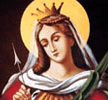
St Ursula
Patron Saint
One of the legends pictures Ursula as the daughter of a king of Britain. The king desired for a son, God gave him instead a baby-girl, but with the heart of a man. The child was called Ursula, because one day she would strangle the devil, as David had done once with the bear. In Latin ’Ursus’ means bear. Raised according to her state, yet detached from the riches of the world, Ursula longed for spiritual things and meditated day and night on the law of God.
One of the ancient legends describes St. Ursula as the daughter of a king of Britain. The king had long desired a son, but God blessed him instead with a daughter who possessed the courage and strength of a man. She was named Ursula, a name connected with the Latin word Ursus, meaning “bear.” It was believed that one day she would overcome the devil, just as David had once defeated the bear.
Ursula was brought up according to her royal position, yet she remained detached from the riches and pleasures of the world. From her childhood, she developed a deep love for spiritual things and spent much of her time meditating on the law of God. The son of a pagan and barbarian king sought her hand in marriage. However, through a heavenly dream, Ursula was assured that she would receive the crown of martyrdom. She therefore agreed to the marriage only on certain conditions.
She asked that her father and her future husband select ten young companions for her. Each of these companions, including Ursula herself, was to be accompanied by another thousand young women. Eleven ships were to be provided, and they were to be given three years to live together in virginity and prepare themselves spiritually.
Thus began the great adventure of the virgins. Ursula travelled with her vast company, many of whom were pagans. Her face and heart were filled with joy as she gave thanks to God. She eventually revealed to her companions the purpose of their journey and began to instruct them in the love and service of God. The young women listened attentively. With their hands and hearts raised towards heaven, they committed themselves to Christ with the determination of soldiers pledging loyalty to their king. They promised to remain faithful to their religious duties and to encourage one another in living them faithfully.
The spiritual transformation of these young women took place during their journey by sea, which continued for three years. A great storm eventually drove their ships away from Britain towards the Rhine. During this journey, Ursula offered her nuptial song to Christ, her heavenly Bridegroom. One night, a heavenly messenger appeared to her in a vision and announced that she was to make a pilgrimage to Rome, then return to Cologne, where she and her companions would receive the crown of martyrdom. When Ursula shared this vision with the others, they received the news with joy and courage.
When they reached Cologne, the Huns attacked the young women with great violence and cruelly massacred the innocent group. The story of Ursula and her countless companions soon spread throughout medieval Europe. From about 1106 onwards, the discovery of an ancient Roman cemetery at Cologne contributed greatly to the development of the legend. Because of the enormous number of bones found there, the people of Cologne believed that they had discovered the burial place of Ursula and her companions. Thus, the famous legend of the “Eleven Thousand Virgins” gradually received widespread acceptance. Over the centuries, many additional details and stories were added, and devotion to St. Ursula became widespread.
Historical research today confirms that a group of virgins was indeed martyred at Cologne sometime between the third and fourth centuries. They soon became objects of Christian devotion, and their memory survived despite the barbarian invasions. However, reliable historical documents do not provide definite information about their exact number, their names, or the precise circumstances of their martyrdom.
St. Ursula continues to hold a special place in the hearts of the Ursulines because of her close connection with the foundation of the original group known as the Company of St. Ursula, established by St. Angela Merici. Ursula and her companions, the virgin martyrs of the fourth century, deeply inspired Angela through their faith, purity, courage, and unwavering fidelity to Christ, even unto death.
Angela therefore chose St. Ursula as the patroness of her Company because she represented the ideals that Angela and her companions desired to live. The members of the Company were young women who would remain amid the world while dedicating themselves to God. They were placed under the protection of St. Ursula so that, following her example, they too might have the courage and strength to preserve their purity and innocence and to remain faithful to Christ throughout their lives.
