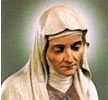
St Angela Merici
Patron Saint
St. Angela Merici was born around the year 1474 at Desenzano del Garda, in Brescia, a prosperous fishing port and an important grain market. Her father, John Merici, was an agriculturist, while her mother, Catherine, came from Salò. Angela grew up in a loving, simple, and deeply Christian family. The atmosphere of her home was honest and wholesome, far removed from the corruption and worldly spirit that characterized much of the society of that time.
St. Angela Merici was born around the year 1474 at Desenzano del Garda, in Brescia, a prosperous fishing port and an important grain market. Her father, John Merici, was an agriculturist, while her mother, Catherine, came from Salò. Angela grew up in a loving, simple, and deeply Christian family. The atmosphere of her home was honest and wholesome, far removed from the corruption and worldly spirit that characterized much of the society of that time.
Angela spent her childhood at Grezze, in a farmhouse a few kilometres from Desenzano. Life there followed the natural rhythm of the day and the seasons. The family shared the work of the fields and household, gathered for common prayer, and often spent evenings in prayer and reflection. Her father would read to the family stories about the saints and the lives of holy virgins. These experiences planted deep seeds of faith in the young Angela and gradually shaped her spiritual life.
When Angela was about sixteen, she experienced a series of painful losses. Within a short period, she lost her father, her sister, and her mother, perhaps because of an epidemic. Her maternal uncle then took her to Salò, where she was introduced to a more urban way of life. The change could easily have drawn her away from the simplicity, hard work, austerity, and prayer to which she had been accustomed. Instead, Angela remained firmly faithful to her way of life. At Salò, she was even able to devote more time to prayer and receive Holy Communion more frequently after becoming a Franciscan Tertiary, something that would otherwise have been difficult for her.
It is not certain when or for what reason Angela returned to Desenzano. Once there, she resumed her household responsibilities and work in the fields with great dedication. Even while engaged in ordinary duties, she remained closely united with God. She devoted herself generously to works of mercy, gave alms to the poor, visited the sick, encouraged those who were weak in faith, and offered wise advice to those who were troubled or uncertain.
She probably spent about fifteen years in Desenzano. These were years of hidden preparation. Away from public attention, Angela strengthened her character, deepened her relationship with God, and quietly prepared herself for the mission that God would later entrust to her.
A Divine Call
Perhaps during this period, an extraordinary event took place in Angela’s life. It was harvesting time, and during a break from her work, Angela withdrew to pray. Suddenly, she experienced a vision in which the heavens seemed to open before her. She saw a procession of angels and virgins, and from heaven she heard a message:
“Before you die, you will found a Congregation of virgins.”
This experience became deeply significant in Angela’s life. She understood it as a divine indication of the mission God was preparing for her. Although the full meaning of the vision would become clear only many years later, Angela carried this message within her heart and remained faithful to God’s call.
Angela Comes to Brescia
In 1516, Angela went to Brescia. Her Franciscan superiors had entrusted her with the task of comforting Lady Catherine Patengola, who had suffered the loss of her husband and two sons. Angela went to her with compassion and faith, fulfilling the mission entrusted to her.
After completing this task, Angela had originally intended to return to Grezze. Instead, she remained in Brescia. Her stay there brought her into contact with many influential people and introduced her to different aspects of Brescian society.
For some time, she lived in the home of John Antony Romano, a young businessman who regarded her with deep filial affection. Angela earned her livelihood through the work available to her and continued to live a simple and austere life devoted to prayer and service.
A Time of Trial and Trust
The political situation in Italy soon became unsettled. In 1527, imperial troops attacked Rome, and by 1529 Brescia was also under threat. Because of the danger, Angela took refuge in Cremona with the family of Augustine Gallo.
Even in Cremona, her reputation for holiness attracted many people. Her room became a place where people continually gathered to seek her spiritual guidance, encouragement, and counsel.
During this period, Angela became seriously ill, and it appeared that she might die. Jerome Patengola, a nephew of Catherine Patengola who had also accompanied them from Brescia, prepared an epitaph for her. Surprisingly, the thought of death did not frighten Angela. Instead, she experienced great joy at the thought of heaven. When she recovered, she spoke with happiness about the glory and joy of eternal life.
When peace and stability returned, Angela and the others went back to Brescia. For a few months, she stayed with the Gallo family until she was able to settle near St. Barnabas Church. Eventually, she took up residence in a small room adjoining St. Afra Church, where she spent the final years of her life.
A Woman of Deep Faith
Angela undertook several pilgrimages to strengthen her faith and renew her spiritual fervour. She travelled to Mantua to venerate the tomb of Blessed Osanna Andreasi. She also undertook a pilgrimage to the Holy Land, travelled to Rome during the Jubilee Year of 1525, and later went to Varallo to renew and deepen the spiritual experience she had received during her journey to the Holy Land.
Meanwhile, Angela was gradually gathering a group of young women around her. She guided them in prayer and spiritual formation, helping them to discover their vocation and dedicate themselves more completely to God.
The Company of St. Ursula
Angela’s long preparation eventually led to the foundation of the Company of St. Ursula. On 25 November 1535, she officially began the Company with 28 young virgins as its first members.
She chose St. Ursula as the patroness of the Company. Ursula was widely venerated in Italy during the Renaissance and was remembered as an early Christian martyr who had consecrated her life to Christ. Her example of faith, purity, courage, and fidelity deeply inspired Angela and the young women who joined her.
In 1536, Angela obtained episcopal approval for her Rule, and the Company of St. Ursula was formally recognized. In 1537, the members of the Company gathered and unanimously elected Angela as their Mother, Mistress, and Treasurer for life. The work that had begun quietly in Angela’s heart had now become a living community dedicated to God and to the service of others.
Her Final Days
As Angela’s earthly life was ending, she prepared carefully for the future of the Company. She dictated her Counsels for those who would be responsible for guiding the community. She also prepared her Testament, especially for the matrons and noble widows of Brescia, who in many ways served as a support and guarantee for the Company before both civil and religious authorities.
Finally, the day of her death arrived. Angela Merici died peacefully on 27 January 1540, in her small room at St. Afra. She was dressed in the habit of a Franciscan Tertiary. Her earthly journey had come to an end, but the spiritual work she had begun would continue through generations of women inspired by her vision. She was buried in the crypt of St. Afra Church in Brescia.
The Church continued to recognize her holiness. Pope Clement XIII declared Angela Blessed on 30 April 1768, and Pope Pius VII canonized her on 24 May 1807. Her feast is celebrated by the universal Church every year on 27 January.
A Legacy
St. Angela Merici was a woman who discovered God in the ordinary circumstances of life. Through prayer, simplicity, service, courage, and deep trust in God, she transformed a quiet and hidden life into a mission that would touch countless generations.
Her greatest legacy was the Company of St. Ursula, through which she opened a new path for women to dedicate themselves to God while remaining actively present in the world. Her life continues to inspire the Ursuline family to live with faith, compassion, purity of heart, courage, and faithful service.
