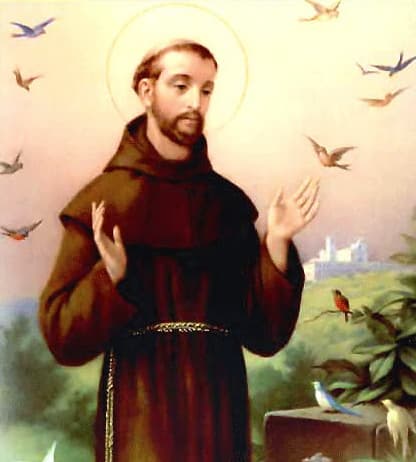
St Francis Of Assisi
Patron Saint
At the end of the 11th century, few could have imagined that anything remarkable would emerge from Assisi. The town was troubled by internal divisions, social conflicts, and rivalry with neighbouring cities, especially Perugia. Yet, by the end of the 13th century, people across Europe could only marvel at the transformation that God had brought about, not only in Assisi but throughout the Church, through the life and mission of St. Francis of Assisi and his followers.
At the end of the 11th century, few could have imagined that anything remarkable would emerge from Assisi. The town was troubled by internal divisions, social conflicts, and rivalry with neighbouring cities, especially Perugia. Yet, by the end of the 13th century, people across Europe could only marvel at the transformation that God had brought about, not only in Assisi but throughout the Church, through the life and mission of St. Francis of Assisi and his followers.
From a Life of Ambition to a Life of Faith
Francis was the first of the two sons of Lady Pica and Peter Bernardone, a wealthy merchant of Assisi. He was baptized John, but when his father returned from a business journey, he gave him the name Francis.
According to his first biographer, Thomas of Celano, Francis spent the early years of his life enjoying the pleasures and ambitions of youth. He dreamed of becoming a great and honourable knight and lived a carefree life, spending much of his father’s wealth. But God was gradually preparing him for something greater.
His experience as a prisoner after the war between Assisi and Perugia became an important turning point. Later, while travelling towards Spoleto, Francis experienced a mysterious dream that caused him to question the direction of his life. Slowly, he began to realize that there was a Master who was calling him to a different kind of service.
His heart was gradually transformed. He began to understand that true greatness did not lie in wealth, social position, military glory, or worldly honour. Instead, he was being invited to conquer himself, surrender his possessions and ambitions, and place God at the centre of his life.
“Francis, Go and Repair My House”
One of the most decisive moments in Francis’ conversion occurred while he was praying before the crucifix in the little church of San Damiano. Christ Crucified spoke to his heart:
“Francis, go and repair my house, which, as you see, is falling into ruin.”
At first, Francis understood these words literally. He began repairing old and neglected churches, especially the church of San Damiano. He worked with his own hands and willingly embraced poverty and simplicity. Gradually, however, Francis came to understand the deeper meaning of Christ’s command. God was not merely asking him to rebuild stone walls. He was calling him to help renew the Church through the power of the Gospel.
Francis eventually separated himself from his former way of life. He left behind the security of his family, wealth, ambitions, and worldly status and embraced a life of poverty and service. He called himself a “herald of the great King” and began proclaiming the Gospel through both his words and his way of life.
The Gospel Comes Alive
Francis’ radical way of living soon attracted others. Men from Assisi and the surrounding towns were inspired by his example and chose to leave everything behind to follow Christ. Before long, companions came from different parts of Italy, and eventually from many countries of Europe. They were not wealthy or powerful men. They were simple people who had been set on fire by the spirit of the Gospel.
They travelled from place to place, preaching repentance, peace, reconciliation, simplicity, and love. Their lives themselves became a living proclamation of the Gospel. Wherever they went, they invited people to turn away from sin and return to God.
Francis wanted his followers to imitate Christ as closely as possible. In the beginning, his own life served as their living example. As their numbers increased, however, he realized that their way of life needed clearer guidance and organization. He therefore expressed their ideals and practices in a written form. This became the Rule and Life of the Friars Minor, forming the foundation of the First Order of St. Francis.
St. Clare and the Second Order
Francis’ examples also touched the heart of a young woman from Assisi, Clare. Fascinated by his radical commitment to Christ and inspired by his love for the Gospel, Clare desired to dedicate her entire life to God.
With Francis as her spiritual guide, Clare embraced a life of poverty, prayer, simplicity, and contemplation. Other young women gradually joined her, and together they formed a community that would become the Second Order of St. Francis, known today as the Poor Clares. Francis also provided them with a way of life rooted in the Gospel and adapted to their contemplative vocation.
Thus, through Francis and Clare, a new spiritual movement was growing—one that called both men and women to live the Gospel with sincerity and complete dedication.
Francis and His Desire for Martyrdom
Deep within Francis’ heart was a profound desire to give himself completely to Christ, even though martyrdom. He longed to witness to the Gospel among those who did not yet know Christ.
With this desire, he travelled to the Holy Land, where the Crusades were being fought between Christians and Muslims. Francis hoped to meet the Muslim leaders and proclaim the message of Christ to them.
Although he was not granted the grace of martyrdom, his journey became a powerful witness to his courage, humility, and desire for peace. He sought not victory through violence but conversion through love and the proclamation of the Gospel.
The Stigmata of Mount La Verna
In 1224, Francis withdrew to Mount La Verna for a time of prayer and solitude. There, while contemplating the Passion of Christ, he received a profound spiritual grace. He was marked with the stigmata, the wounds of Christ. The marks of the Crucified Lord appeared on his body, and Francis carried these wounds with great humility and suffering until the end of his life.
In this extraordinary way, Francis became a living image of Christ Crucified. The Cross was no longer simply something he preached about; it had become deeply united with his own life. His suffering brought him into an even deeper union with the Christ whom he had loved and followed throughout his life.
His Testament and Final Days
As his earthly life ended, Francis dictated his Testament to Brother Leo, leaving behind a precious testimony of his spiritual journey and his deep gratitude for God’s grace. In it, he recalled how the Lord had led him from a life centered on worldly ambitions to one devoted entirely to Christ, the poor, and the Gospel. With humility and love, he encouraged his brothers to remain faithful to the simplicity, poverty, prayer, and evangelical life they had embraced. His Testament became a final expression of his love for God, his brothers, and the Franciscan way of life he had received as a gift.
